Finding a dead bird can stop you in your tracks. Most often, the dead bird meaning points to an ending, a change and a fresh start.
What Does a Dead Bird Meaning?
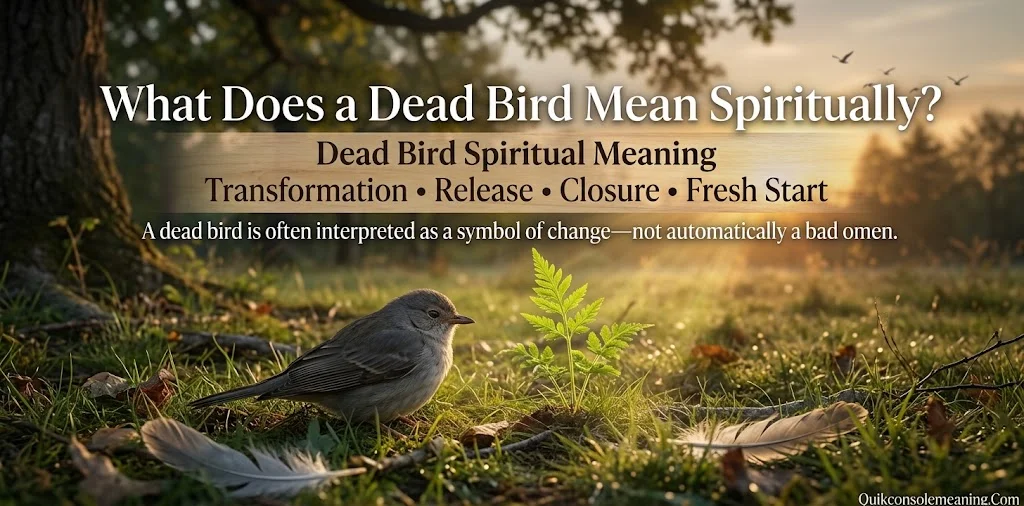
The dead bird spiritual meaning is mostly about change, not doom. Here is the short answer first.
A dead bird usually symbolizes transformation, release and the end of a life chapter. Many traditions read it as a spiritual message to let go of what is finished. It is rarely a literal bad omen.
Birds stand for freedom, the soul and the link between earth and sky. So a still bird feels like a pause in that story. It asks you to look inward.
Timing matters too. People notice a dead bird more during stress, grief or big choices. The bird did not cause the feeling. It simply mirrored what you already carried.
Now the facts. Birds die all the time, and mostly for plain reasons. Researchers estimate that up to 1 billion birds die from glass collisions each year in the US. Free-roaming cats kill an estimated 2.4 billion birds a year. North America has also lost nearly 3 billion birds since 1970.
So seeing a dead bird is common. Hold the symbolism gently. Use it as a prompt for reflection, not as a prediction.
A dead bird can symbolize endings, transformation, or a shift in perspective, while other unusual life experiences can carry their own spiritual interpretations. For a deeper look at signs connected with the beginning of life, explore the spiritual meaning of being born with eyes open and the symbolism people associate with it.
11 Spiritual Signs of Seeing a Dead Bird
Where you find the bird, and which bird it is, can shape the hidden message. Use these signs as a guide, not a rule.
- Ending and new beginning: The core sign. One chapter closes so another can open. Think of a job, a home or a season of life.
- Release of the old: The bird points to a habit, a bond or an old version of you that has run its course.
- Dead bird on porch or doorstep: A doorway is a threshold. Many read this as a message arriving or a change at your door.
- Dead bird in your yard or inside the house: The yard links to family and home life. Inside the house, it often means a bird got trapped. Spiritually, it may point to a shift in your sense of safety.
- Dead bird on your car or the road: A car stands for your path. Some see a nudge to slow down and check your direction. Practically, roads and parked cars see many bird strikes.
- Dead cardinal: Cardinals are tied to loved ones who have passed. Finding one can feel tender. Many take it as a call to honor a memory.
- Dead crow or blackbird: Black birds carry themes of mystery and deep transition. A dead crow often signals closure after a draining stretch.
- Dead white bird or dove: White birds suggest peace and the soul. A dead dove may point to peace that was interrupted, or a spiritual passage.
- Dead baby bird: Often read as lost potential or a hope that did not unfold. It invites gentleness with yourself. In nature, many nestlings do not survive their first weeks.
- Two or more dead birds: Two can mean the end of a shared chapter, like a partnership. Three or more suggest a bigger cycle closing. See the safety steps below before you read into it.
- Dead bird in a dream: A dead bird dream meaning is usually about inner change. It can point to a hope that faded, a creative block or a choice you keep delaying.
A few more birds come up often. A dead robin can hint at renewal that stalled. A dead blue jay may point to a voice you have held back. A dead hummingbird can speak of fragile joy. A dead owl is linked to wisdom and transition. A dead eagle is tied to strength and is treated with deep respect in many cultures.
The sight of a dead bird can feel like a powerful symbol of change, endings, or transformation, especially when it appears unexpectedly. In a similar way, encountering a rat can carry its own symbolism, with the spiritual meaning of a rat crossing your path often linked to hidden concerns, resourcefulness, and personal awareness.
Cultural and Religious Meanings of a Dead Bird
No single tradition owns this symbol. The dead bird omen shifts with belief, history and place.
- Native American traditions: Birds are often seen as messengers between the earthly and spiritual worlds. A dead bird fits the natural cycle of life and death. Sacred birds like the eagle are handled with ceremony.
- Christian view: Many believers think of providence. In Matthew 10:29, not one sparrow falls without God’s notice. The message is care, not fear.
- Hindu view: Birds are linked to the soul and to ancestors. A dead bird may be read as a message about the departed, or about karma and transition.
- Chinese view: Birds can be tied to ancestors and to balance. Some see a gentle reminder to slow down.
- Islamic view: Most scholars discourage reading omens. A well-known hadith in Sahih al-Bukhari says there is no bad omen (tiyarah).
- Ancient Greek view: Life moved in cycles, so death often led to rebirth.
- European folklore: Older superstition treated a dead bird as an omen of sorrow. This is where much of the modern fear comes from.
The range is the point. You can choose the reading that feels calm and true to you.
What to Do If You Find a Dead Bird
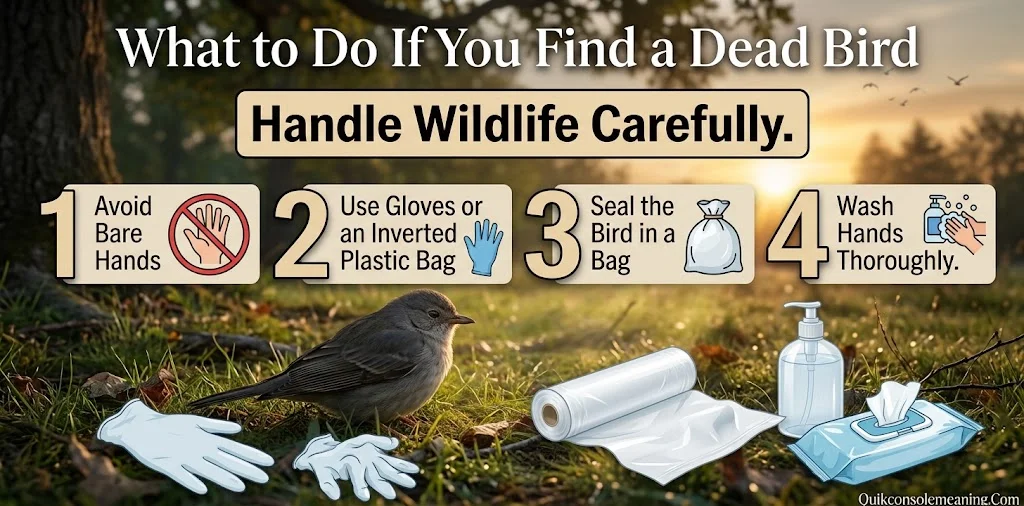
Honor the moment, but handle the bird safely first. Birds can carry germs, and a few simple steps keep you protected.
- Do not use bare hands. Wear disposable gloves, or turn a plastic bag inside out over your hand.
- Seal it. Place the bird in a bag, then a second bag. Throw it in the trash, or bury it deep in your yard.
- Wash up. Scrub your hands with soap and water. Wash tools too.
- Leave the feathers. Under the Migratory Bird Treaty Act, it is illegal to keep feathers or parts of most native birds.
- Report a dead eagle. Contact the U.S. Fish and Wildlife Service. Eagle remains go to the National Eagle Repository.
When should you report a dead bird? Report clusters. That means several birds in one place over a few days, birds of one species, or birds that looked sick before they died. Call your state wildlife agency or state veterinarian. The USGS National Wildlife Health Center tracks wildlife disease across the US.
Multiple deaths can point to avian influenza, salmonellosis or West Nile virus. The CDC also shares guidance on bird flu.
Several birds near a feeder? Take it down. Clean it with a 10 percent bleach solution. Pause feeding for a couple of weeks.
Several birds below one window? Add spaced decals or screens. Small fixes can stop repeat strikes.
If the sight stirs grief, that is normal. Pause. Take a slow breath. You may bury the bird or say a quiet word. Many people find that small ritual brings closure.
FAQs
Is finding a dead bird bad luck spiritually?
No. Finding a dead bird is not bad luck in most spiritual views. Most traditions read it as an ending, a change or a release. The bad luck idea comes mainly from older European superstition. There is no scientific proof that it brings misfortune.
Is a dead bird a warning?
Rarely. Spiritually, it is seen as a nudge to reflect, not a warning of harm. Practically, a cluster of dead birds can signal disease or poison, so report it to your state wildlife agency. A single bird is usually a window strike or a predator kill.
What do you do if you find a dead bird?
Do not touch it with bare hands. Use gloves or an inverted plastic bag. Seal it in a bag, throw it in the trash or bury it, then wash your hands well. If you find several dead birds, report them to your state wildlife agency.
Is it rare to see a dead bird?
No, it is common. Billions of birds die each year in the US from window strikes, cats and other causes. Still, scavengers and weather clear most birds fast. So you see only a small share. Seeing one is normal, not rare.
Conclusion
The dead bird meaning most often points to closure, change and renewal. Treat the moment with care. Handle the bird safely, reflect on what is ending, and welcome what comes next.

I’m a passionate writer and language enthusiast who enjoys making words, phrases, slang, and everyday expressions easier to understand. I create clear, straightforward explanations that help readers quickly discover the meaning, usage, and context behind unfamiliar words.