
Carino meaning depends on the language. In Spanish, cariño means affection and works as a sweet term of endearment. In Italian, carino means cute, nice, or kind.
This guide covers seven meanings, the Latin roots, and the quiet messages tucked inside this small word.
Carino Meaning in Spanish and Italian
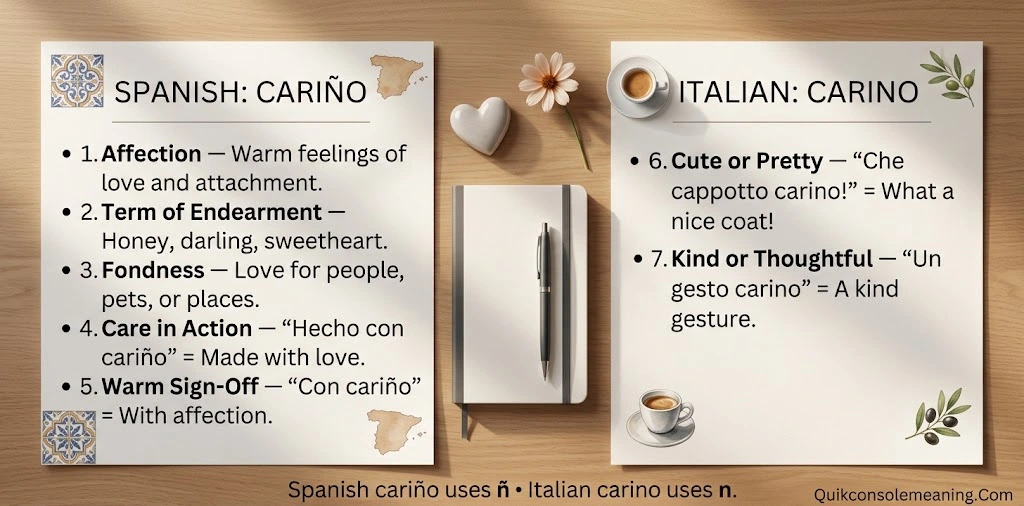
The two words look alike but live in different languages. Here are the 7 meanings of carino, from tender to playful.
- Affection: A warm, gentle feeling that sits between fondness and love. The Real Academia Española describes it as a feeling of love or attachment toward someone or something.
- Term of endearment: Like “honey,” “darling,” or “sweetheart.” Example: “Cariño, ya llegué.” (“Honey, I’m here.”)
- Fondness for people, pets, and things: “Le tengo mucho cariño a mi barrio.” (“I’m very fond of my neighborhood.”)
- Care shown through action: “Hecho con cariño” means “made with love.”
- A warm sign-off: Con cariño works like “with love” or “warmly” at the end of a note.
- Italian “cute” or “pretty”: “Che cappotto carino!” (“What a nice coat!”)
- Italian “kind” or “thoughtful”: “Un gesto carino” means a kind gesture.
English has no single match for cariño. “Love” feels too strong. “Like” feels too weak. “Affection” sounds clinical. That is why people call it an untranslatable word, much like Portuguese saudade or Danish hygge.
How do you say carino? Spanish: kah-REE-nyoh. Italian: kah-REE-noh.
How do you type ñ? On iPhone and Android, hold the “n” key. On Mac, press Option + N, then N. On Windows, hold Alt and type 164 on the number pad. Many people search “carino” without the ñ, but the Spanish word needs it.
The word “carino” is often associated with affection, tenderness, and meaningful emotional connections, reminding us that symbolism can appear in many forms. Similarly, exploring duck spiritual symbolism can reveal fascinating interpretations related to emotional balance, adaptability, intuition, and moving peacefully through life’s changes.
Carino Origin and Etymology
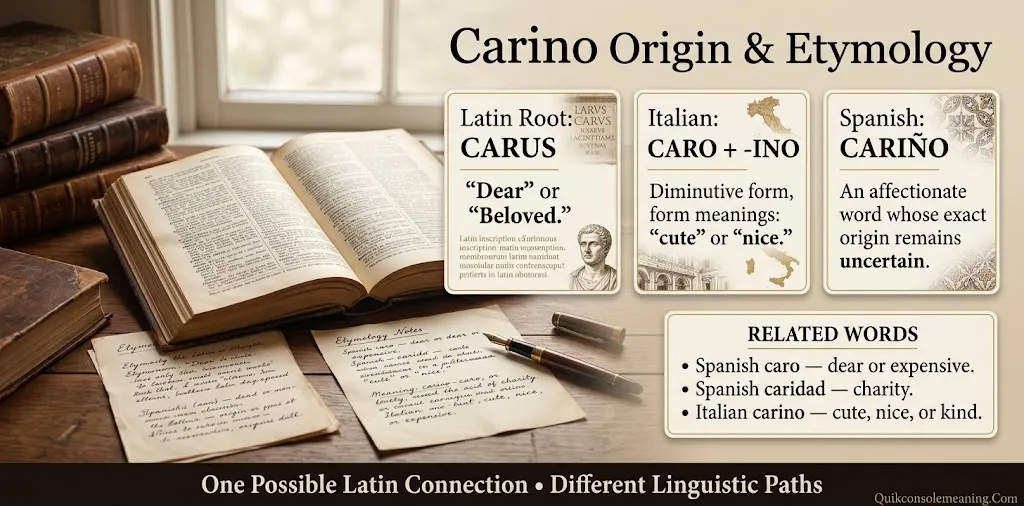
Both words lean on the Latin idea of “dear” and “precious.” The exact path is still debated.
For Spanish, Wiktionary calls the origin uncertain. It points to a possible link through Aragonese carinyo from Latin carēre. Other sources connect it to Latin carus, meaning “dear” or “beloved.”
Italian is clearer. Carino grows from caro (“dear”) plus the diminutive ending -ino, which adds a small, soft touch. At first it described prettiness. Over time, it also came to describe kindness.
The same Latin root gave Spanish caro (“dear” and “expensive”) and caridad (“charity”). One root, many shades of care.
The word also travels well in the United States. The U.S. Census Bureau reports 70.1 million Hispanic residents as of July 1, 2025. That is 21% of the population. Pew Research Center charts the same milestone. So cariño is heard daily in American homes, texts, and songs.
Hidden Messages Behind Carino
A tiny word can carry a big message. Tone, context, and relationship change what it says.
In Spanish, cariño is warm but not as intense as te amo. It is a safe, tender middle ground. It fits partners, kids, grandparents, close friends, and even pets. A closing line like “con mucho cariño” signals sincere warmth. It does not always signal romance.
In Italian, carino is a mild compliment. It is softer than bello (“beautiful”). Sometimes it is a polite cushion. Say a friend shows you a gift you don’t love. “Carino!” keeps the peace.
Timing matters. Italian carino can sound too casual at a job interview or a funeral. It can also shrink a big win. “How cute, you got promoted” does not honor the moment. “Congratulations” does.
Quick guide:
- Safe: a birthday card, a text to a partner, a note to a child, a friendly sign-off.
- Awkward: a formal speech, serious news, or a major achievement.
Similar words: mi amor, mi vida, cielo, and querido/a in Spanish. Dolce, gentile, and grazioso in Italian.
The word “carino” often conveys affection, tenderness, and warmth, reminding us how meaningful symbols can be in everyday life. In a similar way, encountering a white moth and its spiritual symbolism is often associated with purity, transformation, hope, and messages of new beginnings.
FAQs
Can I call my boyfriend Carino?
Yes, with the right spelling. In Spanish, cariño is a common, sweet nickname for a partner. In Italian, carino is an adjective. You say “sei carino” (“you’re cute”) rather than use it as a pet name.
Is Carino for boys or girls?
Both. Spanish cariño is a masculine noun, but people use it for anyone. Italian changes the ending: carino for a male, carina for a female.
When a girl calls you cariño?
It usually shows warmth and affection. The meaning depends on the relationship and tone. It can be friendly, family-style, or romantic. Look at the setting and how she says it.
Is cariño Spanish or Italian?
Cariño (with ñ) is Spanish and means affection. Carino (no ñ) is Italian and means cute, nice, or kind. They are two different words that look alike.
Conclusion
Cariño is affection in Spanish. Carino is “cute” or “kind” in Italian. Same Latin spark, two warm paths.
Next time you write a note, try ending it with con cariño. Small word, big heart.

I’m a passionate writer and language enthusiast who enjoys making words, phrases, slang, and everyday expressions easier to understand. I create clear, straightforward explanations that help readers quickly discover the meaning, usage, and context behind unfamiliar words.